Reducing Lore’s database round trips
How Lore moved admission into a request’s transaction and batched database work, plus the Worker path that still needs measurement.
Lore used to send many database statements one after another for a single request. A typical memory read took 11–12 network waits, while a keyed memory write took 15–20. With a database connection behind a network proxy, those waits can dominate the request even when each query is quick. These are statement and wait counts from Lore’s database-wave specification, not a production latency benchmark.
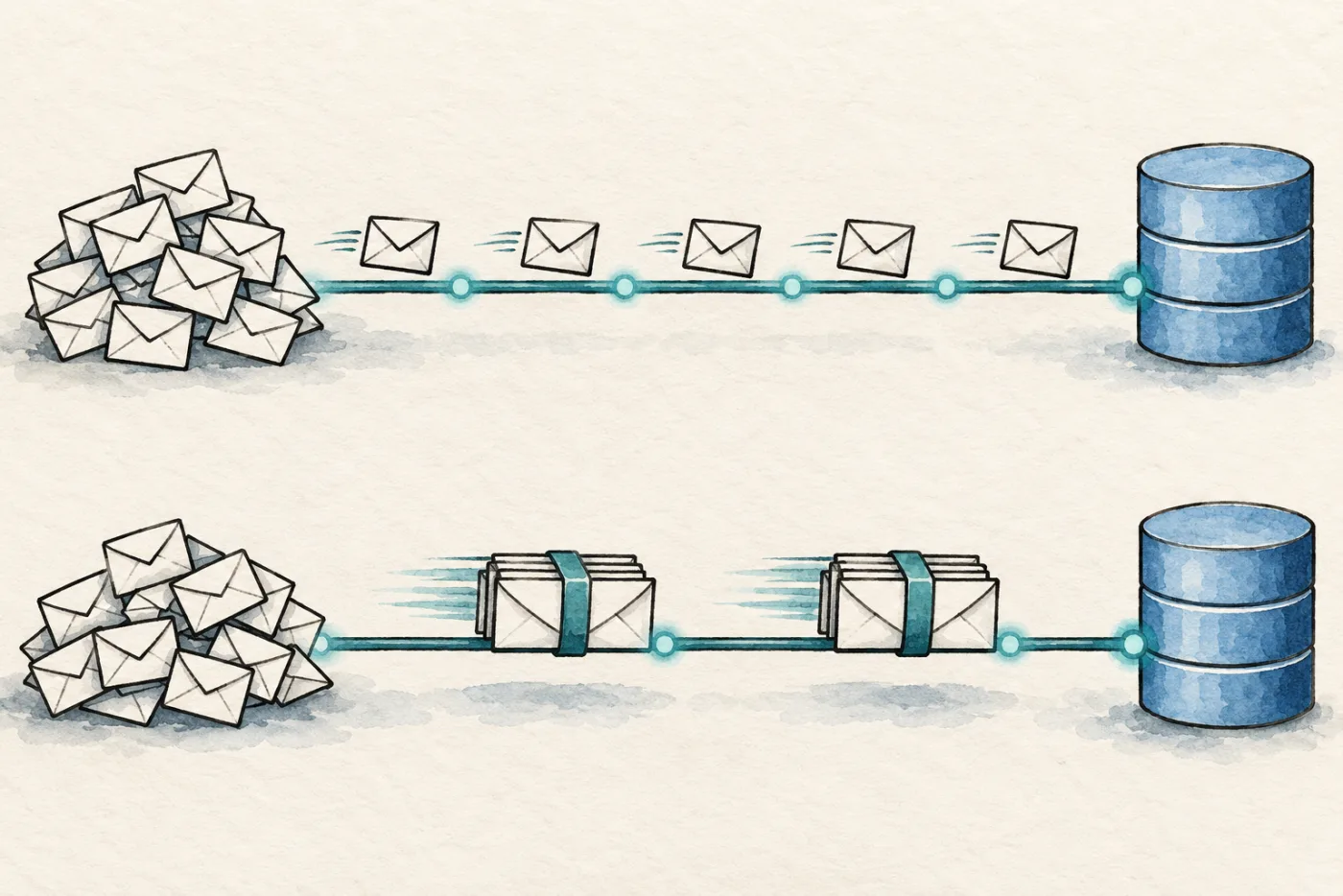
The merged database wave tackled the transaction shape first. The request’s identity and workspace admission now run at the start of its business transaction. The database adapter can send independent statements as a batch, then wait once for the results. The application still performs the authorization checks and reads through row-level security; fewer waits do not mean skipping either one.
- Admit in transactionIdentity and workspace checks start the business transaction.
- Batch independent SQLThe adapter sends statements together where possible.
- Wait for resultsReads need one wait on a pipelined connection; dependent writes need two.
What one wait means
The round-trip tests count a wait whenever a statement goes out while nothing else is in flight. They run the real OSS database adapter over a test PostgreSQL session, with only the socket replaced to count statements and waits. On a pipelined Bun or self-hosted connection, a human memory read now sends six statements in one network wait. A keyed memory creation sends 13 statements in two waits. The write needs a second batch because its final response and replay record depend on the result of the first batch. The test pins both budgets.

The figure shows the memory-read path. It uses the previous count and the as-built counts. The old range is shown at its lower bound; its upper bound is marked separately.
Keep the result of a write tied to that write
Batching makes a subtle race visible. A caller can lose write authority between the first locking read and the later update. Re-reading the memory afterward cannot reliably tell whether that update happened: the same policy may now hide the row. Lore’s write statement therefore records its outcome in a transaction-local setting. The idempotency ledger builds the replay response from that outcome inside the transaction. A replay cannot report that a write happened when the write matched no row. The as-built design describes this case and the two-batch write path.
The same wave also stops rewriting unchanged memory content, chunks, and embeddings. A PATCH that changes nothing keeps its version, update time, and ETag, and produces no event or job. That matters for write load as much as the network schedule does. The merged PR records the behavior and its exceptions.
The Worker result is different
Pipelining is enabled for Bun and self-hosted connections. It remains off for Cloudflare Workers until the team tests correctness and latency through a real Hyperdrive binding. A Worker memory read now takes six statements and six waits, down from the earlier 11–12 waits, rather than the single wait measured with pipelining on. The spec marks Hyperdrive verification and the proposed SQL write functions as unfinished.
The useful result today is a smaller, tested network budget for the paths whose adapter can pipeline, plus fewer statements on Workers. The missing result is a real Hyperdrive latency measurement. It will decide whether the current two-batch writes are fast enough there or whether moving those writes into SQL functions is justified.